
For Recruitment Teams
Build a Consistent View of Your Hiring Funnel
Your data team uses Dex to model the hiring data already in your warehouse and to define funnel stages and time-to-fill. Recruiters use Viz to visualize and share hiring performance, without re-deriving the funnel every quarter.
Dex
Explore, transform, maintain
Your data team, in the warehouse and the dbt project
Semantic layer
Models, metrics, join paths
One governed set of definitions your team owns
Viz
Dashboards and reports
Business users, answering their own questions
Your Hiring Funnel Is a Black Box
Every recruiting leader asks the same questions: which channels deliver our best hires, where do candidates drop off, and how long does it really take to fill a role? The hard part is rarely the chart. It is that nobody has agreed when the clock on time-to-fill starts, or which stage counts as a drop.
So each report re-derives the funnel from scratch, two versions disagree, and the honest answer to what is working becomes 'we're checking'.
Exmergo puts the definitions somewhere they can be reviewed. Data teams model the existing hiring data in the warehouse with Dex and write funnel and time-to-fill definitions into the semantic layer. Recruiters visualize them in Viz.
Agree on the funnel, then watch it
Step 1 · Data team
Build the foundation with Dex
Your data team points Dex at the hiring data already landing in the warehouse. Dex profiles the tables, authors the dbt models that shape stage transitions and offers, and defines funnel conversion, time-to-fill, and source-of-hire as semantic definitions the team reviews and maintains as the process changes.
Step 2 · Business users
Visualize it with Viz
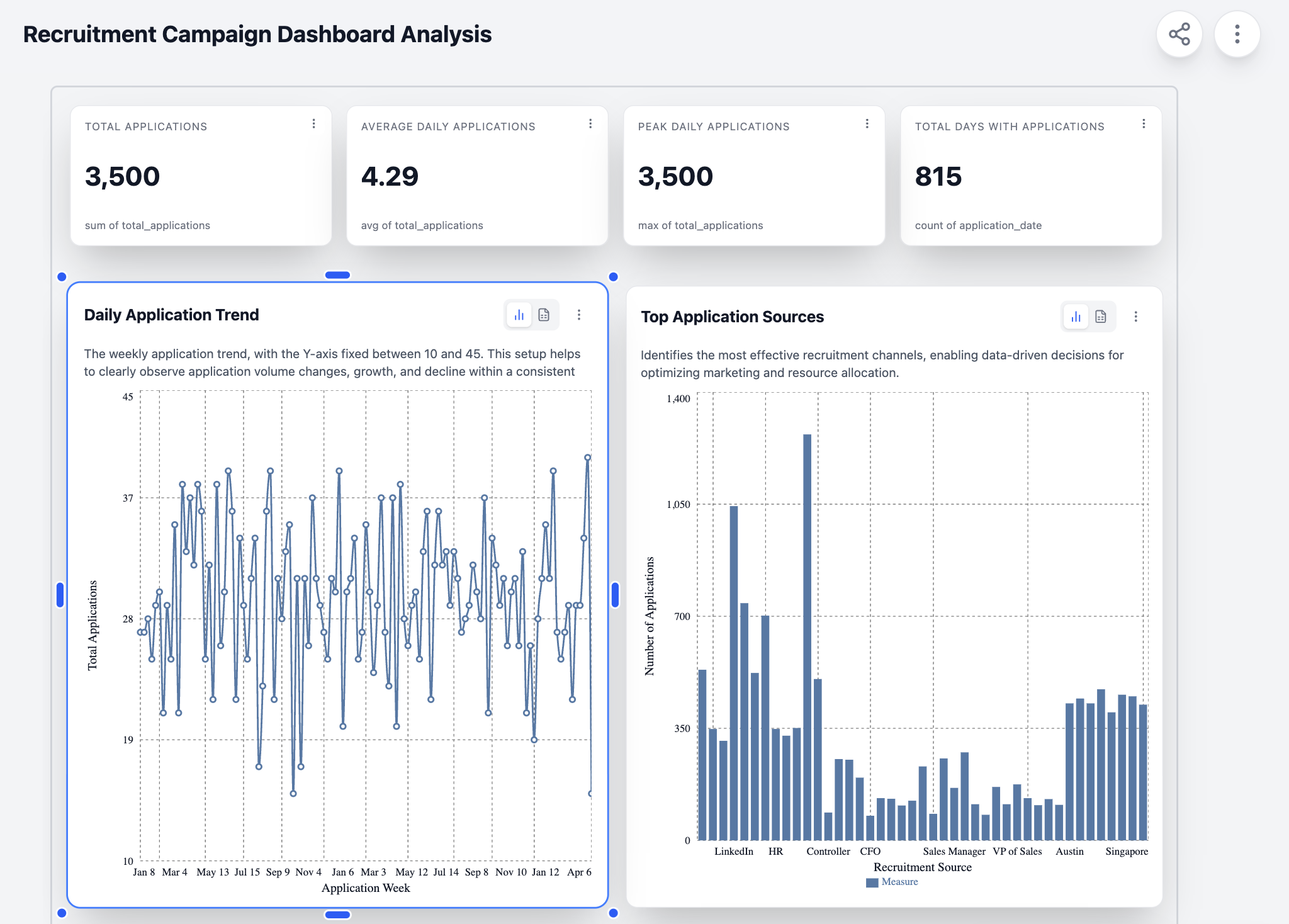
Recruiters and hiring managers open Viz and ask for the funnel by role, team, or channel. Viz builds the interactive view from those definitions, and a published link shares it without handing over the underlying data.
Recruiting Intelligence, Not Recruiting Guesswork
Funnel & Pipeline Dashboards
Visualize conversion from applied to hired at every stage in Viz, built on stage definitions your data team modeled rather than a spreadsheet's best guess.
Source-of-Hire Defined Once
Dex writes the source-of-hire logic into the semantic layer, so channel comparisons mean the same thing in every report and across every quarter.
Time-to-Fill You Can Defend
One definition of when the clock starts and stops, maintained in the dbt project, and charted by role, team, and recruiter in Viz.
One Funnel, Shared Across Hiring
Ask Viz about conversion, time-to-fill, or channel performance and it resolves the question against the hiring definitions your data team maintains with Dex.
What Your Recruiting Team Gets
One agreed definition of the funnel, time-to-fill, and source of hire
Hiring views recruiters build and share themselves
Reports that stay comparable as the hiring process changes